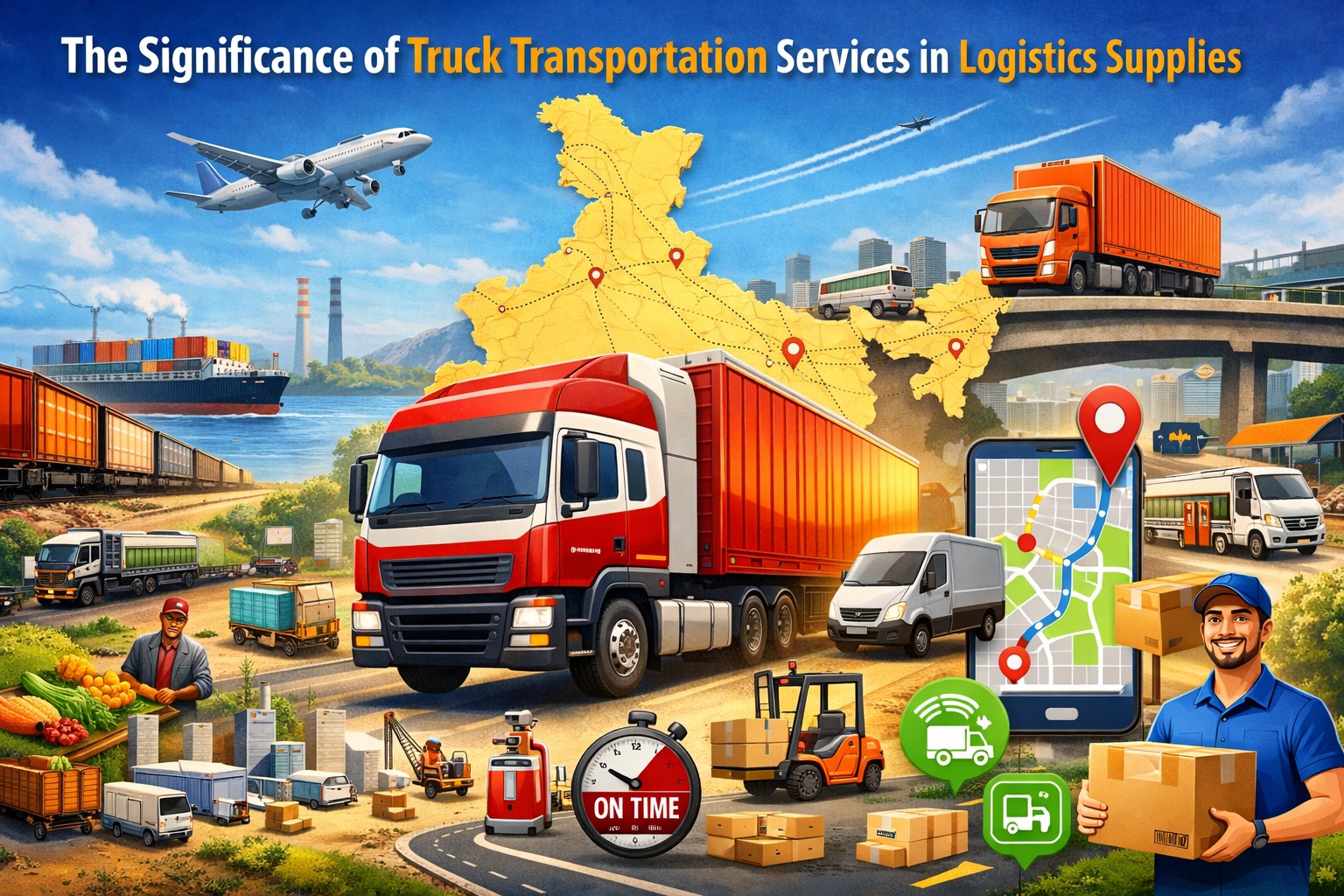
Logistics is what keeps businesses running. Raw materials reach factories. Finished products reach shops. Online orders reach homes. All of this happens because goods move from one place to another, and most of that movement happens by road.
Truck transportation is the backbone of logistics in India. Railways are good for very long distances and bulk cargo. Air freight works for urgent, expensive items. Ships handle international trade. But for getting things from point A to point B within the country, trucks do most of the heavy lifting.
Trains are great for long hauls and heavy bulk cargo. Ships handle imports and exports. Planes move things fast when money is no object. But none of them can pull up to your warehouse door, load your goods, and deliver them to a shop three cities away. Trucks can.
That last-mile access is what sets road transport apart. Even when trains or ships are involved, a truck is almost always part of the chain — picking up from a port, delivering to a factory, dropping off at a retail outlet. You can’t avoid trucks even if you try.
And India’s road network keeps expanding. Highways are better than they were a decade ago. More areas are connected than ever before. This only strengthens the case for road transport.
Walk through any sector of the economy, and trucks show up.
A garment factory in Surat needs fabric from one supplier and packaging from another. Both arrive by truck. The finished clothes go to retailers across the country — by truck again.
A supermarket in Pune restocks daily. The milk, the rice, the soap, the electronics in the corner aisle — each of those came from a different warehouse or supplier, loaded onto a truck somewhere, and driven to that store’s back entrance before sunrise.
A construction project in Hyderabad can’t afford to wait. Cement, steel rods, sand, bricks — the site supervisor tracks deliveries the way a conductor tracks musicians. One missed truck can hold up an entire day’s work.
Farmers in Punjab or Maharashtra know this better than most. Fruits and vegetables don’t wait. If transport is delayed, the produce spoils. Trucks that arrive on time are the difference between a good season and a loss.
E-commerce has made all of this more intense. Every package you order passes through multiple hands — a warehouse, a sorting centre, a local hub, your doorstep. Trucks are at every single transfer point. The growth of online shopping has directly driven growth in road freight.
Speed is part of it. So is flexibility. A truck driver who hits a blocked road doesn’t wait for a rescheduled train — he takes another route. That ground-level adaptability matters enormously across a country as geographically varied as India.
Load sharing has made things more affordable for smaller businesses. If your consignment doesn’t fill a whole truck, you split space with another shipper going the same direction. You pay for what you use. Simple and practical.
GPS tracking has brought a layer of trust that wasn’t there before. You know where your goods are. You can plan around arrivals. You’re not just hoping the truck shows up.
Diesel prices are an ongoing headache. When fuel costs rise, everything transported by road gets more expensive. That ripple effect touches every industry and every consumer.
Road quality outside major highways remains inconsistent. Good national highways give way to rougher state roads, and those slow down vehicles, increase wear, and push up costs.
Driver shortages are a growing problem that doesn’t get enough attention. Trucking is physically demanding, keeps people away from their families for weeks at a time, and doesn’t have the appeal it once did among younger workers. The industry is feeling that gap.
Reliability has also been a long-standing issue. Businesses have been burned by transporters who didn’t deliver on time, didn’t communicate, or returned goods damaged. That erosion of trust is hard to rebuild and makes logistics planning stressful.
Digital booking platforms have genuinely changed how businesses find and hire trucks. What used to involve hours of phone calls and uncertainty can now be done in minutes. You see prices, compare options, and confirm — all in one place. Platforms like Insta Logistics have pushed that transparency forward.
Route planning tools help drivers move more efficiently. Digital invoicing cuts down admin time. Online payments reduce the risks that come with cash transactions on long routes.
None of this is flashy. But it adds up to a system that works better than it did even five years ago.
One thing experienced logistics managers will tell you: cheap and reliable are not the same thing. A bargain transporter who loses your shipment or delivers a week late costs you more than a dependable one ever would.
Getting the truck size right matters too. An oversized truck for a small load wastes your money. Splitting a big load across too many small vehicles wastes it differently. Good planning finds the balance.
Seasonal demand is real. Around festivals, during harvest periods, trucks are in high demand. Prices go up, availability drops. Businesses that book early and plan around those cycles consistently get better outcomes.
Electric trucks are coming, slowly. The infrastructure isn’t quite there yet, but the direction is clear. Lower fuel costs and reduced emissions will eventually make them mainstream.
Fully automated trucks are still a long way off in India. The roads, the regulations, and the technology all need to catch up. Drivers will remain essential for the foreseeable future.
Highways will keep improving. Digital tools will become more powerful. The fundamentals of road transport — flexibility, accessibility, direct delivery — aren’t going anywhere.
Trucks are not a glamorous part of the economy. Nobody makes films about logistics. But pull trucks out of the picture, and factories stop, stores empty, construction halts, and supply chains collapse.
Every product on every shelf got there because someone drove it there. That’s what truck transportation does, quietly and consistently, every single day across India. Insta Logistics offers top-grade truck transport services in India.